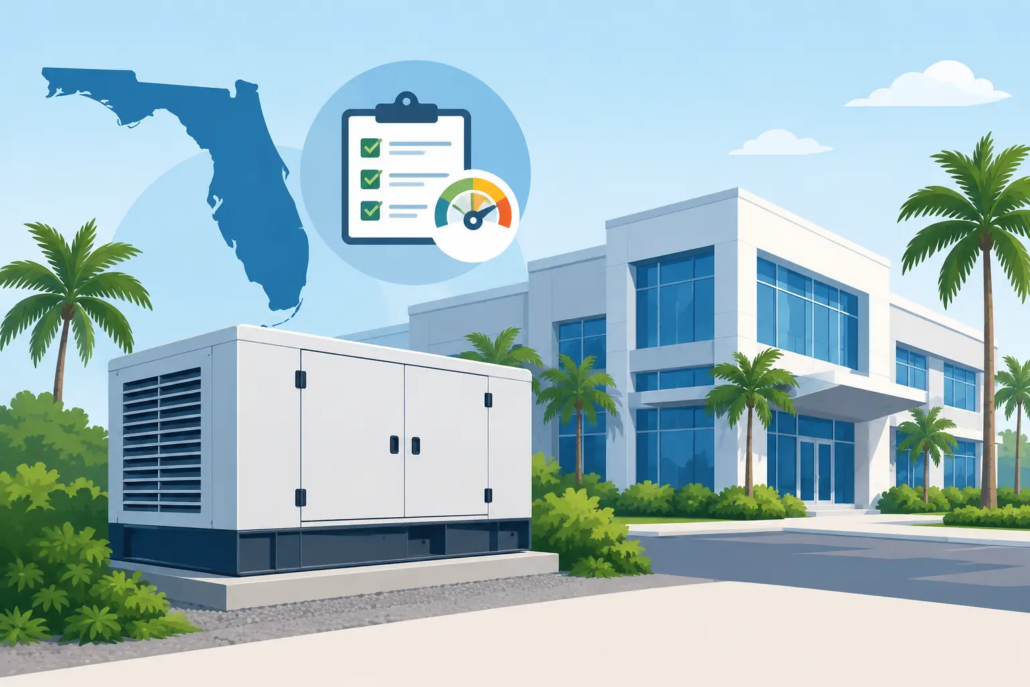
Generator Capacity Assessment for Florida Buildings
A generator that starts but cannot carry the building’s essential systems is not a backup-power solution. A properly executed generator capacity assessment determines what the generator must support during an outage, how those loads behave at startup, and whether the electrical distribution system can deliver power safely when it matters most.
For commercial properties, multifamily communities, hotels, offices, warehouses, and mixed-use buildings, the question is rarely just, “How large should the generator be?” The better question is, “Which operations must continue, under what conditions, and through what electrical infrastructure?” The answer affects life safety, code compliance, equipment reliability, operating continuity, and the cost of the project.
What a Generator Capacity Assessment Evaluates
A generator capacity assessment is an engineering review of the building loads, generator equipment, transfer equipment, distribution system, and operating requirements. It establishes whether an existing generator is adequately sized, whether planned additions will exceed available capacity, or what size generator is appropriate for a new installation.
Nameplate ratings alone do not provide the answer. A generator may be rated at 250 kW, for example, but its usable output depends on voltage, power factor, ambient conditions, fuel arrangement, load characteristics, and the sequence in which equipment is connected. A building may also have sufficient total generator capacity on paper while still experiencing a voltage dip or frequency drop when a large motor starts.
The assessment should distinguish between continuous operating loads, intermittent loads, and motor-driven loads with elevated starting demand. It should also identify the systems that are legally required to remain operational versus systems the owner elects to maintain for business continuity or resident comfort.
Start With the Loads That Cannot Go Dark
The first engineering decision is defining the emergency or standby-power scope. In a multifamily high-rise, that may include fire alarm, emergency lighting, exit signage, fire pump equipment, smoke-control systems, selected elevators, domestic water or sewage equipment, communications, and limited common-area lighting. A retail or office property may prioritize life-safety systems, security, server equipment, refrigeration, point-of-sale equipment, and selected HVAC loads.
Not every load belongs on generator power. Including every available circuit can make a project unnecessarily expensive, increase fuel consumption, and complicate the transfer and distribution design. Conversely, excluding a critical pump, elevator function, or communications system can create an operational failure during an extended outage.
This is where owner priorities and code requirements must be evaluated together. Emergency systems, legally required standby systems, and optional standby systems are treated differently under the National Electrical Code. NEC Articles 700, 701, and 702 establish distinct requirements for these categories, including wiring separation, transfer equipment, and system performance. Where a generator supports life-safety functions, applicable NFPA standards and the authority having jurisdiction may impose additional requirements.
Load Inventory Is More Than a Panel Schedule
An accurate assessment begins with field verification. Existing panel schedules can be useful, but they are often outdated after tenant improvements, equipment replacements, renovations, or undocumented circuit changes. Engineers should compare available documentation with actual equipment ratings, feeder sizes, panel capacities, disconnects, and transfer-switch configurations.
The load inventory typically captures connected load, demand load, voltage, phase, power factor where available, and whether the equipment is resistive, electronic, or motor-driven. For motors, the review should identify horsepower, starting method, and whether the equipment can be sequenced to avoid a damaging inrush event.
A fire pump, chiller, large exhaust fan, booster pump, elevator, or refrigeration compressor can have a major effect on generator selection. Motor starting is one of the most common reasons a generator that appears correctly sized fails to perform as expected.
Why kW Is Not the Only Number That Matters
Generator capacity is commonly discussed in kilowatts, but generator performance also involves kilovolt-amperes, power factor, voltage regulation, frequency response, and transient load acceptance. These factors become particularly relevant in buildings with variable-frequency drives, elevators, UPS systems, medical equipment, or significant electronic loads.
A generator rated for a specific kW output at a stated power factor may not support the same mix of loads under different conditions. Harmonic-producing equipment and nonlinear loads can affect alternator heating and voltage waveform quality. Large motor loads can impose high starting kVA even when their normal running kW is modest.
The practical result is that a simple sum of connected equipment ratings is not a capacity assessment. Engineering calculations must account for demand, diversity, load sequence, and the real operating condition expected during an outage.
Load Sequencing Can Reduce Cost and Improve Performance
In many facilities, the right answer is not a larger generator. It is a better operating sequence.
Automatic transfer switches, generator controls, and building automation systems can be configured to bring priority loads online in stages. Life-safety systems may connect immediately, followed by pumps, elevators, refrigeration, or designated HVAC equipment after short delays. Load shedding can also disconnect lower-priority equipment when generator capacity approaches its limit.
Sequencing must be designed, documented, and tested. It should not rely on facility staff manually deciding which breakers to open during an emergency. A controlled sequence can reduce starting demand, protect sensitive equipment, and avoid oversizing the generator solely to accommodate simultaneous starts that will never be required in actual operation.
Evaluate the Entire Emergency Power Path
A generator is only one part of the system. A complete generator capacity assessment reviews the path from generator output to the equipment being served.
This includes automatic transfer switches, generator breakers, feeders, distribution panels, overcurrent protection, grounding and bonding, disconnecting means, fuel systems, ventilation, exhaust routing, and remote annunciation where required. The review may also identify whether existing electrical rooms have adequate working clearances or whether the proposed equipment location creates access, fire-rating, flood, or maintenance concerns.
For Florida properties, site conditions deserve close attention. Outdoor generator installations may require consideration of wind exposure, flood elevation, drainage, corrosion resistance, enclosure integrity, and access after a storm. A generator that is properly sized but inaccessible, flooded, overheated, or blocked by debris is not dependable emergency infrastructure.
Fuel supply is equally critical. Diesel generators require adequate tank capacity and fuel-quality management for the anticipated outage duration. Natural gas generators avoid on-site fuel storage but depend on utility service and gas-pressure availability during emergency conditions. Neither option is universally better. The appropriate choice depends on critical load, required runtime, site constraints, maintenance capability, local approvals, and the building’s risk profile.
Existing Generators Need Reassessment Before New Loads Are Added
EV chargers, renovation projects, upgraded fire protection equipment, new pumps, tenant buildouts, and electrical service modifications can all change the generator load profile. An existing generator may have been properly designed for the building years ago and still be inadequate for its current configuration.
This concern is especially relevant when an owner plans to add equipment that must remain energized during an outage. The assessment should determine whether the new load belongs on the emergency system, whether the transfer switch has available capacity, and whether downstream panels and feeders can support the revised design.
It may be possible to retain the existing generator by reallocating circuits, adding a dedicated transfer switch, using load shedding, or separating optional loads from life-safety loads. In other cases, replacement or parallel generation may be the more reliable long-term solution. The right path depends on the condition of the equipment, available space, outage requirements, budget, and anticipated future growth.
Testing Validates the Engineering Assumptions
Calculations are essential, but field testing confirms performance. Once improvements are complete, the system should be tested under conditions that reflect its intended operation. That may include transfer testing, load-bank testing, verification of motor starts, staged load pickup, alarm checks, and review of voltage and frequency stability.
Testing should also confirm that life-safety equipment receives power in the required sequence and that facility personnel understand the operating procedures. A test that only proves the engine starts does not confirm that the building can operate safely during a real outage.
Documented test results provide valuable evidence for facility records, maintenance planning, inspections, insurer discussions, and future renovation decisions. They can also reveal issues early, when corrective work is more manageable and less disruptive.
When Professional Engineering Review Adds Value
A generator capacity assessment is most valuable before procurement, permitting, or construction begins. Early analysis prevents costly equipment changes, avoids underperforming installations, and gives owners a defensible basis for capital decisions.
For projects involving life-safety systems, major electrical modifications, permit submissions, or aging building infrastructure, licensed PE oversight provides the calculations and construction-ready documentation needed to move forward with confidence. Boukzam PE Consulting approaches these reviews with a practical focus: protect required systems, identify real constraints, and develop clear, code-compliant solutions that work in the field.
Backup power should be planned for the outage your property is most likely to face, not the one assumed by a generic equipment schedule. A disciplined assessment turns that planning into a system your building can depend on when normal power is no longer available.


Leave a Reply
Want to join the discussion?Feel free to contribute!