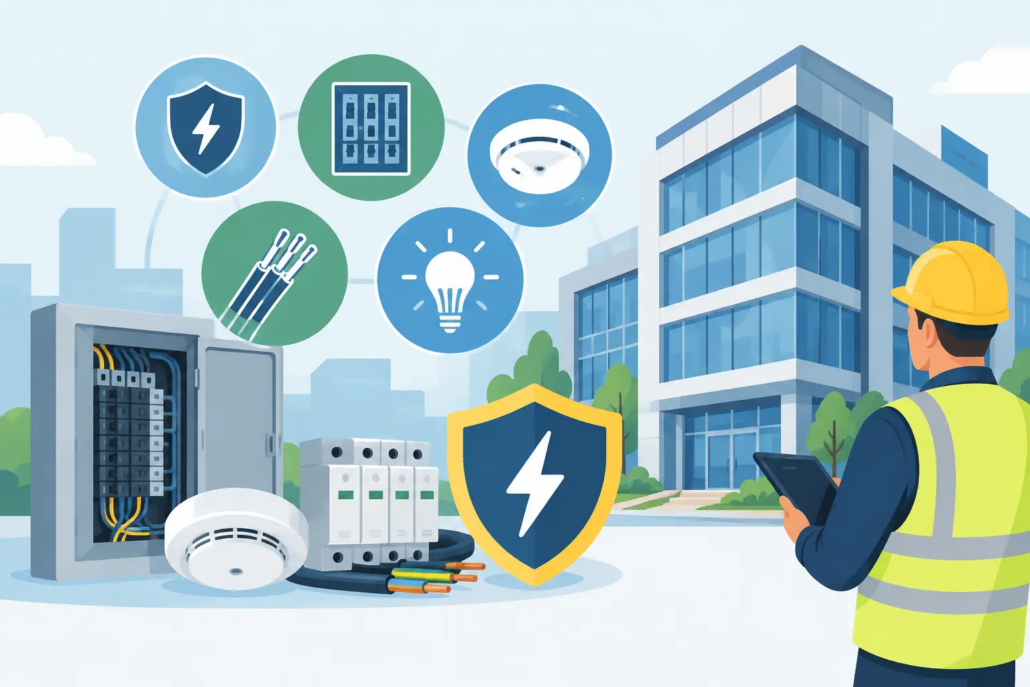
8 Best Electrical Safety Upgrades for Buildings
An overloaded panel, a corroded disconnect, or a missing ground-fault device can turn a manageable maintenance issue into an outage, fire exposure, failed inspection, or liability event. The best electrical safety upgrades are not simply the newest products on the market. They are targeted improvements based on a building’s age, occupancy, load profile, maintenance history, and applicable code requirements.
For Florida property owners, condominium boards, facility managers, and developers, the right scope begins with an engineering-based assessment. Electrical upgrades should protect occupants and assets while supporting practical goals: permit approval, reliable operations, future capacity, and controlled capital costs.
Start With an Electrical Condition and Capacity Assessment
A safety upgrade plan should begin with facts, not assumptions. Many commercial and multifamily properties have experienced years of tenant improvements, equipment replacements, temporary repairs, and added loads that were never evaluated as one coordinated electrical system.
A qualified assessment reviews the condition and capacity of service equipment, switchgear, panels, feeders, overcurrent protection, grounding and bonding, emergency systems, and branch circuits. It should also identify signs of deterioration such as overheating, corrosion, water intrusion, loose terminations, damaged enclosures, obsolete equipment, unlabeled circuits, and improperly installed breakers.
Load calculations are equally important. A panel may appear to have open breaker spaces while lacking sufficient calculated capacity for added HVAC equipment, common-area renovations, kitchen upgrades, laundry equipment, or EV charging. Open space is not the same as available electrical capacity.
For aging buildings and properties preparing for renovation, recertification-related work, or a change in occupancy, this assessment creates a defensible basis for prioritizing repairs and capital improvements.
1. Upgrade Unsafe or Obsolete Panels and Service Equipment
Aging electrical panels and switchgear can create significant operational and safety concerns, particularly when replacement parts are unavailable, equipment has visible damage, or field modifications have compromised the original listing and installation.
Panel replacement may be warranted when equipment shows heat damage, corrosion, repeated breaker failures, incompatible breakers, inadequate fault-current ratings, or evidence of overloading. In coastal and high-humidity environments, corrosion inside outdoor service equipment and electrical rooms requires close attention. A panel that still energizes a building is not necessarily safe or suitable for continued service.
A properly engineered replacement can improve reliability, provide necessary working clearances, increase capacity where justified, and create space for future circuits. The trade-off is cost and potential downtime. Phasing work, scheduling outages strategically, and coordinating with the utility can reduce disruption, but those considerations need to be addressed during design rather than after permits are issued.
2. Install Whole-Building Surge Protective Devices
Surge protective devices help reduce damage from voltage spikes caused by lightning, utility switching, and large equipment cycling. In Florida, where lightning exposure is a practical concern, surge protection is a cost-conscious layer of defense for sensitive building systems.
A service-level surge protective device can help protect elevators, fire alarm components, access-control systems, HVAC controls, communications equipment, appliances, and tenant-connected electronics. Depending on the facility, additional protection at distribution panels or dedicated equipment may also be appropriate.
Surge protection is not a substitute for grounding, bonding, or lightning protection design where required. It is one part of a coordinated electrical safety strategy. Device selection should consider the system voltage, available fault current, enclosure location, and the equipment being protected.
3. Correct Grounding and Bonding Deficiencies
Grounding and bonding are often misunderstood because they are largely invisible during normal building operation. Yet they are essential to providing a path for fault current and helping protective devices operate as intended.
Common deficiencies include missing bonding jumpers, improperly bonded water piping, undersized grounding electrode conductors, damaged grounding connections, and modifications that separated metal components from the required bonding path. Renovations can introduce these issues when contractors alter piping, replace service equipment, or add subpanels without addressing the complete system.
Correcting grounding and bonding deficiencies should be based on field verification and current code requirements. A generic repair can create more problems if it ignores the building’s service configuration, generator system, separately derived equipment, or existing lightning protection components.
4. Add GFCI and AFCI Protection Where Applicable
Ground-fault circuit-interrupter protection, commonly called GFCI protection, is designed to reduce shock hazards in areas where electricity and moisture may come into contact. It is especially relevant in bathrooms, kitchens, laundry rooms, rooftop areas, garages, pool-related spaces, exterior locations, maintenance rooms, and other wet or damp environments.
Arc-fault circuit-interrupter protection, or AFCI protection, addresses a different risk: electrical arcing that can result from damaged conductors, loose connections, or deteriorated wiring. Its applicability depends on the occupancy type, scope of work, and code edition governing the project.
These devices can be valuable upgrades, but installation should not be handled as a blanket exercise. Nuisance tripping can occur when existing wiring defects or incompatible equipment are present. A qualified evaluation identifies the cause rather than bypassing the protective device or replacing it with a standard breaker.
5. Improve Electrical Room Safety and Access
Electrical rooms are frequently used as storage areas, which can block required working space, restrict emergency access, and increase fire risk. A critical upgrade may be as direct as restoring code-required clearances, installing durable equipment identification, and establishing room-use controls.
Electrical safety improvements in these spaces may include replacing damaged panel directories, labeling disconnects and feeders, improving room lighting, sealing water-entry points, repairing door hardware, and providing clear warning signage where appropriate. If equipment is exposed to flooding, roof leaks, or plumbing failures, correcting the source of moisture is as important as replacing corroded electrical components.
For multifamily communities, clear labeling also supports faster response during unit emergencies and planned maintenance. A maintenance team should be able to identify which equipment serves common areas, life-safety systems, individual units, and major mechanical loads without guesswork.
6. Upgrade Emergency and Life-Safety Power Systems
Emergency lighting, exit signs, fire alarm systems, fire pumps, smoke-control equipment, and other life-safety systems require reliable electrical infrastructure. Their requirements vary by building type, height, occupancy, and installed systems, so a site-specific review is essential.
Older properties may have battery-powered emergency fixtures that no longer provide their required runtime, poorly maintained transfer equipment, or circuits that have been altered during prior renovations. Testing documentation matters. A system that has not been tested and maintained cannot be assumed to perform during a power loss.
Where generators, transfer switches, or emergency distribution systems are part of the facility, upgrades should be coordinated with electrical and fire protection requirements. The objective is not merely to add backup power. It is to ensure that required loads receive reliable, code-compliant power when normal service is unavailable.
7. Replace Deteriorated Wiring and Correct Improper Modifications
Electrical hazards are often found beyond the panelboard. Aging conductors, brittle insulation, aluminum branch-circuit wiring in certain applications, open splices, overloaded extension cords, concealed junction boxes, and unprotected cable runs can all create exposure.
Improper tenant improvements are a recurring concern in commercial and multifamily buildings. Added receptacles, signage, appliances, mini-split systems, and equipment connections may have been installed without permits or without confirming circuit capacity. These conditions can remain hidden until an inspection, equipment failure, or renovation uncovers them.
Corrective work should address the full condition, not just the visible symptom. Replacing a receptacle will not resolve an undersized circuit, damaged conductor, or overloaded feeder upstream. Permit-ready documentation helps ensure repairs are coordinated, inspectable, and suitable for long-term use.
8. Plan EV Charging and New Loads Without Overloading the Building
EV charging is a valuable amenity and a growing expectation for multifamily, hospitality, office, and retail properties. It also introduces sustained electrical load that can expose limited capacity in older services and distribution systems.
The safest approach is to perform a load study before selecting chargers or promising a number of charging spaces. Depending on available capacity, the project may require new feeders, upgraded transformers, additional distribution equipment, load management controls, or a phased installation strategy.
Load management can be a practical solution where a full service upgrade is not immediately justified. However, it must be designed around actual building demand, charger specifications, operational priorities, and utility requirements. A low-cost installation that overloads existing infrastructure can create far greater expense through failed inspections, equipment damage, and delayed occupancy.
How to Prioritize the Best Electrical Safety Upgrades
The highest-priority projects are those that address immediate shock, fire, outage, or life-safety exposure. Evidence of overheating, water-damaged equipment, loose or burned conductors, repeated breaker trips, unsafe panels, blocked electrical rooms, and deficiencies affecting fire protection or emergency systems should move quickly to the top of the list.
The next tier should focus on upgrades that reduce foreseeable risk and support planned improvements, such as surge protection, capacity additions, circuit protection, equipment labeling, and EV readiness. Finally, include long-term modernization items in the capital plan so they can be coordinated with roofing, mechanical replacement, tenant renovations, or larger building improvements.
A precise electrical scope protects more than equipment. It supports safer occupancy, cleaner inspections, more predictable construction pricing, and stronger documentation for the people responsible for the property. Before approving the next electrical repair or amenity project, confirm that the work solves the underlying risk and moves the building toward a safer, code-compliant future.

