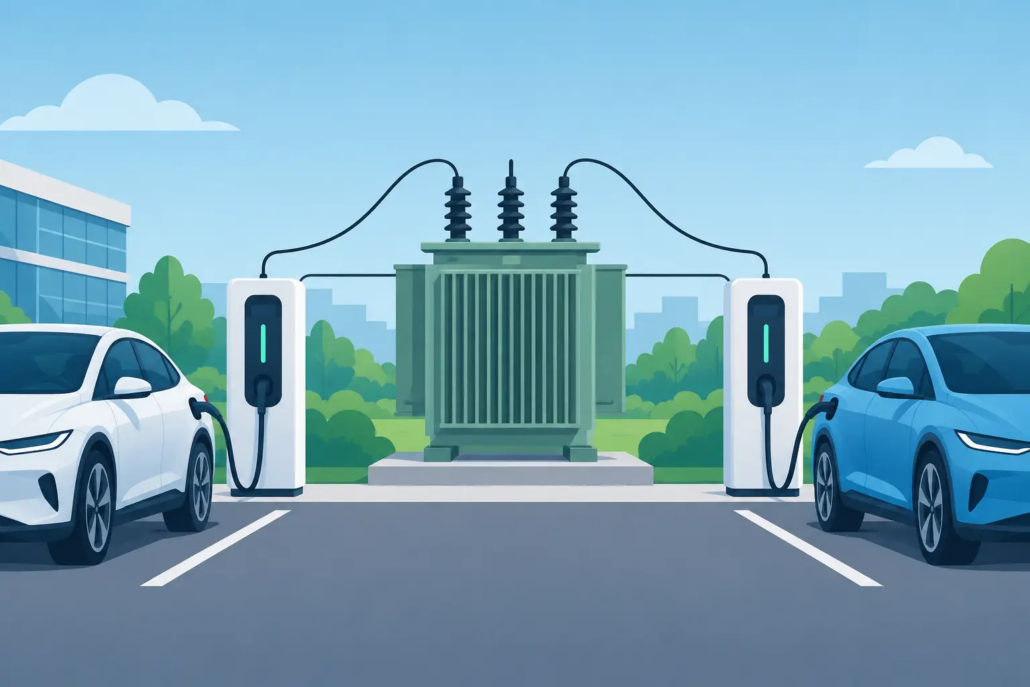
Can EV Chargers Share Transformers Safely?
A property may have an apparently underused transformer, yet that does not mean it has room for EV charging. Can EV chargers share transformers? Often, yes. But the answer depends on calculated demand, transformer loading, available distribution capacity, utility requirements, and the charging strategy selected for the site. Treating the transformer as spare capacity without an engineering review can create nuisance trips, overheating concerns, failed permits, and expensive corrective work after installation.
For condominium boards, multifamily owners, developers, and facility managers, the practical question is not simply whether chargers can connect to an existing transformer. The question is whether the entire electrical system can support charging safely, code-compliantly, and with enough flexibility for future demand.
Can EV Chargers Share Transformers With Building Loads?
EV chargers can share a transformer with building loads when the transformer and downstream electrical equipment have adequate capacity under applicable load calculations. A shared transformer may serve apartment units, common areas, retail spaces, office loads, HVAC equipment, or other building systems while also supplying EV charging equipment.
That arrangement is common in retrofits because a dedicated transformer can add substantial cost, lead time, site disruption, and utility coordination. It is not automatically the lowest-cost solution, however. The existing service, main switchboard, feeders, panels, and transformer must all be evaluated as part of one system.
A transformer can be within its nameplate rating at a particular moment while the service equipment or feeder serving the charger panel is already constrained. Conversely, a building with significant connected load may still have usable capacity because its calculated demand is lower than its total equipment nameplates. Engineering decisions should be based on documented calculations and field verification, not assumptions based on panel schedules or the apparent size of existing equipment.
The transformer is only one part of the capacity question
A proper assessment traces the electrical path from the utility source or service entrance through the transformer, switchgear, feeders, distribution panels, and EV supply equipment. Each component has a rating, loading history, protective device, and installation condition that can affect the final design.
For example, adding six Level 2 chargers at 48 amperes each can create a significant continuous load. Under NEC requirements, EV charging loads are generally treated as continuous loads, meaning conductors and overcurrent protection must be sized accordingly. A system that appears to have 300 amperes available on paper may have much less usable capacity after continuous-load rules and existing calculated loads are applied.
What an EV Capacity Study Should Review
An EV charging capacity study establishes whether shared-transformer charging is feasible and identifies the least disruptive compliant path forward. For an existing property, this work usually begins with record drawings, utility information, electrical panel schedules, and a site visit to confirm actual equipment ratings and conditions.
The analysis should account for existing building demand, proposed charging load, expected charging behavior, and planned expansion. It should also identify whether the transformer is utility-owned or customer-owned. That distinction matters because utility-owned transformer upgrades often require utility review, new service agreements, construction lead time, and potential contribution costs.
A complete review typically addresses the following items:
- Service and transformer ratings, voltage, phase configuration, and available fault current.
- Main switchgear, meter banks, feeder, and panel capacity.
- NEC load calculations, including the continuous nature of EV charging loads.
- Actual demand data where available, particularly for properties with seasonal occupancy or large HVAC loads.
- Charger output ratings, quantity, operating schedules, and future phases.
- Utility requirements, local permitting requirements, and required protective equipment.
For Florida properties, peak electrical demand is often shaped by cooling loads. A site may have more capacity during mild-weather periods than during high-temperature afternoons, when air-conditioning systems operate near maximum demand. An EV design that ignores those conditions may look acceptable until the property reaches its highest seasonal load.
Load Management Can Make Shared Transformers Practical
Managed charging is often the most effective way to install EV charging without immediately upgrading a transformer or electrical service. Rather than allowing every charger to draw full output at the same time, a load management system monitors or limits charging demand so the EV load stays within a defined electrical capacity.
This approach can work particularly well at multifamily properties, hotels, workplaces, and fleet sites where vehicles remain parked for several hours. Most drivers do not need maximum charging power every minute they are connected. The system can allocate available capacity among vehicles, reduce output when building demand rises, and restore charging power when demand declines.
The design must be specific. A generic claim that chargers are “smart” is not enough for permitting or long-term operations. The selected equipment, control method, load limit, communications architecture, and failure mode should be documented in the construction documents. If communications fail, the system must respond in a safe, code-compliant manner rather than permit uncontrolled charging loads.
Load management also creates a business decision. It can reduce upfront infrastructure cost, but property ownership should understand how it affects driver experience. At a residential building with limited electrical capacity, charging may be slower when many residents plug in at once. Clear operating expectations, billing rules, and future expansion planning help avoid conflict after the stations are commissioned.
When a Dedicated Transformer Is the Better Choice
A dedicated transformer may be the right solution when the EV load is large, predictable, or operationally critical. This is common for fleet charging, high-turnover parking, public fast charging, and developments built around substantial EV adoption. Dedicated infrastructure can isolate EV demand from sensitive building loads and provide a clearer path for future expansion.
It may also be necessary when the existing transformer is already near its calculated capacity, when downstream distribution equipment cannot be economically upgraded, or when the utility requires a separate service arrangement. For DC fast charging, the required capacity can be substantial enough that a separate transformer, new utility service, or dedicated medium-voltage design becomes the practical option.
A dedicated transformer is not a shortcut around engineering review. It still requires coordination of transformer size, primary service, secondary conductors, overcurrent protection, grounding, working clearances, equipment location, and utility access. Site constraints can be decisive, especially where parking layouts, fire lanes, landscaping, and existing underground utilities limit equipment placement.
Code, Permitting, and Documentation Matter
EV charging projects are electrical construction projects, not just equipment installations. Article 625 of the National Electrical Code governs key EV supply equipment requirements, while other NEC provisions apply to load calculations, overcurrent protection, wiring methods, grounding, and service equipment. Florida Building Code requirements, local amendments, utility standards, and the authority having jurisdiction must also be addressed.
Permit-ready documents should clearly show the electrical one-line diagram, load calculations, panel schedules, conductor and conduit sizing, equipment ratings, charger locations, mounting details, circuit identification, and required signage. Where load management is used, the design should identify the maximum permitted EV demand and how the control system enforces it.
For condominiums and multifamily communities, metering and cost allocation deserve early attention. A shared transformer may serve common-area power, but charging costs may need to be assigned to individual users. The electrical design, networked charging platform, and association policies should align before equipment is ordered. Retrofitting a billing strategy after installation can create avoidable operational disputes.
Plan for the Next Phase, Not Just the First Chargers
Installing two chargers today does not mean designing for only two chargers forever. The most cost-conscious approach often provides enough pathway capacity, panel space, spare conduits, and site planning to support future stations without repeating demolition and permitting work.
That does not require oversizing every component for an uncertain future. It requires a phased plan grounded in the property’s parking count, resident or tenant profile, anticipated vehicle turnover, utility capacity, and capital budget. A capacity study may support a first phase of managed Level 2 chargers, reserve infrastructure for a later expansion, and identify the trigger point at which a transformer or service upgrade becomes necessary.
Boukzam PE Consulting approaches EV infrastructure as a building-performance and compliance decision: verify the available capacity, document the design, coordinate the constraints, and install a system that protects safety, schedules, and long-term property value. The right transformer strategy is the one that gives your property reliable charging capacity without placing hidden stress on the electrical system.

