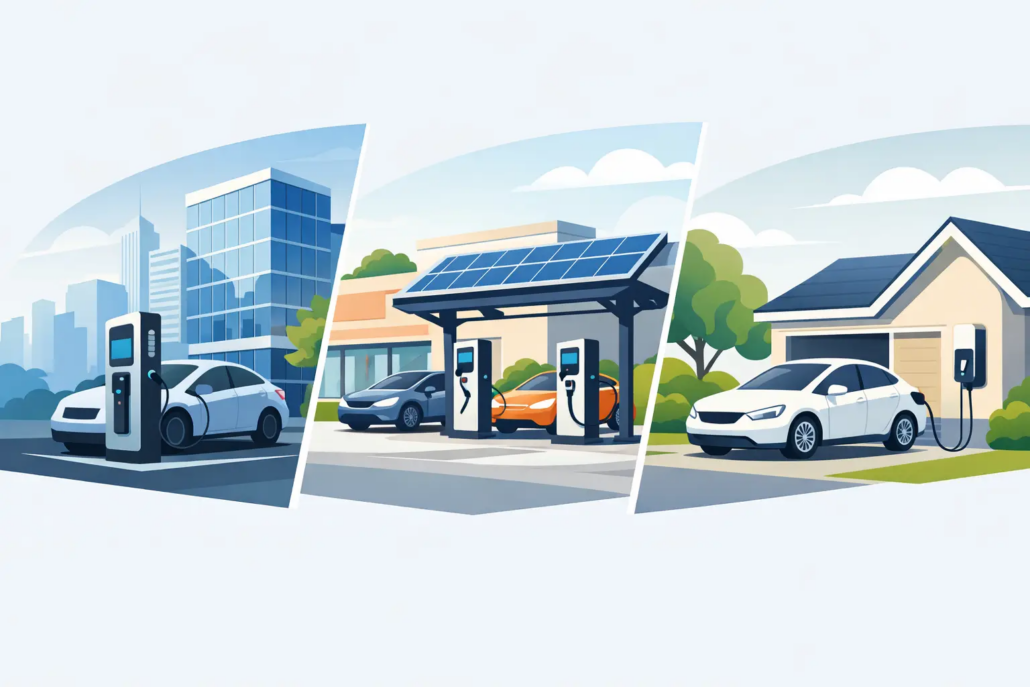
EV Charging Infrastructure Comparison for Properties
A useful EV charging infrastructure comparison starts with a building question, not a charger question: what can the property safely support today, and what should it be ready to support five or ten years from now? For a condominium, hotel, office, retail center, or multifamily community, the wrong approach can create electrical bottlenecks, permit revisions, resident friction, and unnecessary replacement costs.
The right approach matches charging speed, electrical capacity, parking use, ownership model, and code requirements. A licensed engineering review turns those variables into a practical installation plan that protects the property and keeps the project moving.
EV Charging Infrastructure Comparison: The Main Options
Most commercial and multifamily charging projects fall into three categories: Level 1 charging, Level 2 charging, and DC fast charging. Each serves a different use case, carries different electrical demands, and changes the scope of design and construction.
Level 1: Low-Cost Charging for Long Dwell Times
Level 1 charging uses a standard 120-volt connection. It is the lowest-cost entry point because it may not require major electrical upgrades when suitable existing circuits are available. Charging is slow, typically adding only a few miles of range per hour.
For an apartment resident who parks overnight or an employee who leaves a vehicle at work all day, Level 1 can be adequate. It is generally not the strongest choice for guest-facing parking, public-access facilities, or properties seeking a meaningful amenity that supports broad EV adoption.
Level 1 installations still require careful review. Existing receptacles, branch circuits, load capacity, weather exposure, equipment listing, and physical protection all matter. A simple outlet is not automatically a compliant or durable EV charging solution.
Level 2: The Practical Standard for Most Properties
Level 2 charging operates at 208 or 240 volts and is the most common choice for multifamily, hospitality, workplace, and commercial properties. It provides substantially faster charging than Level 1, commonly delivering enough energy for daily driving during an overnight stay or several-hour visit.
For many Florida properties, Level 2 offers the best balance of cost, performance, and user value. It can support assigned resident spaces, shared charging areas, employee parking, fleet vehicles, and visitor charging. It also allows owners to select networked equipment with access control, billing, utilization reporting, and load-management capabilities.
Its trade-off is electrical demand. Multiple Level 2 chargers can require significant feeder capacity, new distribution equipment, transformer upgrades, trenching, and service modifications. The equipment itself may be a modest portion of the total project cost when long conduit runs or utility work are involved.
DC Fast Charging: High Output, High Infrastructure Demand
DC fast chargers provide rapid charging for drivers who need to recharge during a short stop. They are typically best suited to retail destinations, highway-adjacent sites, fleet hubs, large hospitality properties, and publicly accessible locations with strong traffic demand.
The charging experience is compelling, but the electrical and civil scope is much more demanding. DC fast charging may require medium-voltage utility coordination, a larger transformer, switchgear modifications, substantial concrete pads, site drainage considerations, communications infrastructure, and protective bollards. Demand charges and operating costs can also affect the business case.
A property should not select DC fast charging simply because it is the fastest technology. If vehicles remain parked for several hours, well-designed Level 2 charging may provide better value with lower capital exposure and less site disruption.
Electrical Capacity Is the First Design Decision
The most common early mistake is counting available breaker spaces instead of evaluating actual electrical capacity. A panel may have open spaces while the building service, feeder, transformer, or panel load calculation leaves little room for added continuous load.
EV charging must be evaluated under applicable electrical code requirements, including National Electrical Code provisions governing electric vehicle supply equipment and continuous loads. The engineering analysis should review the incoming service, main distribution equipment, load history where available, feeder ratings, panel schedules, voltage configuration, grounding, and available fault current.
In older buildings, especially properties undergoing renovation or recertification work, capacity constraints may become visible only after a full electrical assessment. That is why a charger purchase should not come before the design review. Equipment selected without confirming capacity can lead to change orders, delayed permits, or a system that cannot expand as intended.
Managed Charging Can Reduce Upgrade Costs
Load management is often the difference between a phased EV program and a costly immediate service upgrade. A managed charging system monitors or controls charging output so that chargers do not all draw maximum power at the same time.
For example, a multifamily property may install infrastructure for 20 spaces while limiting simultaneous demand based on available capacity. When one vehicle finishes charging or reduces demand, power can be allocated to another. This can help property owners serve more drivers without designing every charger for full coincident demand.
Managed charging is not a substitute for engineering. The controls, communication reliability, operating assumptions, and code-compliant design must be documented. It is, however, a valuable strategy when capacity is limited and future demand is expected to grow.
Compare Infrastructure, Not Just Charger Hardware
The charging station visible in the parking space is only one component of the system. A sound comparison includes the supporting infrastructure required to deliver, protect, meter, operate, and maintain power.
Key variables include electrical distribution upgrades, conduit routing, wire sizing, trenching or concrete cutting, equipment pads, bollards, signage, striping, accessibility considerations, network communications, and utility coordination. In covered garages, architectural constraints, fire-rated assemblies, clearance requirements, and pathways through occupied areas can materially affect cost and construction sequencing.
For a new development, the most cost-effective strategy is often to install pathways and electrical capacity during initial construction, even if chargers are added in phases. Empty conduit, spare panel capacity, reserved transformer capacity, and properly planned parking layouts cost far less before paving, landscaping, finishes, and occupancy are complete.
For an existing condominium or commercial property, a phased strategy may be more appropriate. The property can begin with a limited number of chargers, build in expansion pathways, and monitor utilization before committing to a larger deployment.
Ownership and Access Models Change the Design
A charging system must match the way the property intends to manage access and recover costs. A resident-only condominium installation has different requirements than a retail parking lot open to the public.
Assigned chargers can be simple for private parking spaces, but they raise questions about metering, billing, maintenance responsibility, and what happens when a unit is sold or leased. Shared chargers improve utilization and may reduce the number of stations required, but they need clear rules for reservations, parking duration, pricing, and enforcement.
Networked stations can provide user authentication, payment processing, energy reporting, remote diagnostics, and usage controls. Those features can be valuable for property management, but they also introduce recurring software fees and reliance on communications service. Non-networked equipment may reduce ongoing costs but offers less visibility and control.
Before selecting equipment, owners should establish whether charging is an amenity, a reimbursable utility expense, a revenue-generating service, or a combination of these. The answer informs metering strategy, operating policies, and equipment selection.
Permitting, Safety, and Site Protection
EV charging design should be prepared for permitting, installation, and inspection from the start. That means coordinated electrical drawings, load calculations, equipment specifications, one-line diagrams, panel schedules, mounting details, conduit plans, and site protection details appropriate to the project.
Florida projects must also account for the Florida Building Code, applicable local requirements, accessibility obligations, and the current adopted edition of the NEC. Conditions vary by jurisdiction and property type, so assumptions should be verified before construction begins.
Parking areas need more than electrical power. Chargers may require bollards or wheel stops to prevent vehicle impact, adequate mounting heights, weather-rated equipment, clear circulation space, proper labeling, and safe routing that avoids trip hazards. In garages, coordination with structural elements, ventilation systems, fire protection systems, and egress paths is essential.
For occupied properties, construction planning matters as much as technical design. Work can often be phased around resident access, tenant operations, hospitality guests, or retail traffic. Clear documentation and early field verification reduce surprises once contractors mobilize.
A Better Decision Framework for Property Owners
The best EV charging solution is rarely the one with the highest advertised output. It is the one that fits the property’s electrical condition, parking behavior, budget, growth plan, and operating model.
Start by defining who will charge, how long vehicles typically remain parked, and how many charging spaces the property may need over time. Then evaluate existing electrical capacity and the cost of expansion. Compare Level 2 and DC fast charging against actual dwell time rather than market pressure. Finally, select an ownership and billing model that the property can administer reliably.
Boukzam PE Consulting approaches EV charging station design as an engineering and compliance project first. Permit-ready documentation, licensed PE oversight, and a practical assessment of electrical capacity help owners make decisions with clearer costs and fewer avoidable revisions.
A well-planned EV installation should leave the property better prepared, not more constrained. When the electrical backbone, permitting strategy, and future expansion plan are designed together, charging becomes a durable asset that supports occupants, protects the investment, and keeps the property ready for what comes next.


Leave a Reply
Want to join the discussion?Feel free to contribute!