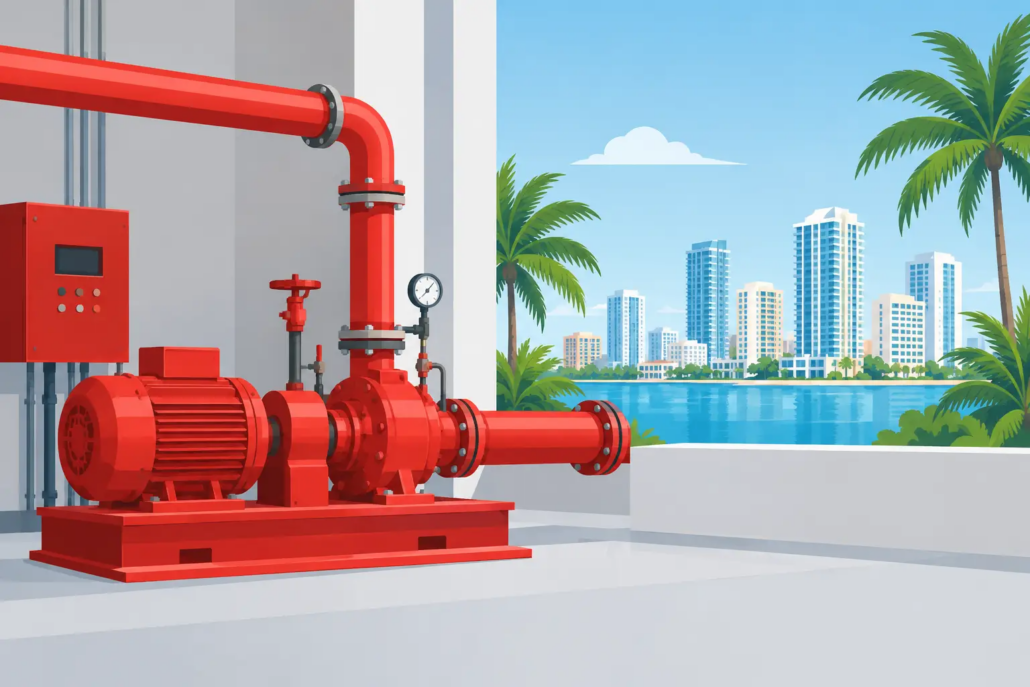
Fire Pump Requirements for Florida Buildings
A fire pump is not selected because a building is large or because a contractor prefers a familiar equipment package. Fire pump requirements begin with one question: can the available water supply deliver the pressure and flow the fire protection system needs during the most demanding fire scenario? If the answer is no, the pump becomes a life-safety component that must be designed, installed, powered, tested, and maintained with precision.
For Florida property owners, developers, condominium boards, architects, and contractors, the consequences of getting this wrong are practical and immediate. A poorly coordinated pump room can delay permits and inspections. An undersized water service can force costly redesign. In an existing building, an unverified or neglected pump can create compliance exposure just when a recertification, renovation, or fire inspection puts the system under closer review.
When Is a Fire Pump Required?
A fire pump is generally required when the public water supply, private water main, or other approved water source cannot provide the hydraulic demand of the building’s fire protection system at the required pressure. That demand may be driven by automatic sprinklers, standpipes, private hydrants, or a combination of these systems.
The need is established through hydraulic calculations, not assumptions. The design team compares the available water supply data with the calculated demand at the point of connection. If the water source cannot satisfy the required flow and residual pressure, a fire pump may be necessary to make up the difference.
This analysis becomes especially significant in high-rise and multifamily properties, warehouses with high-piled storage, hospitality facilities, mixed-use developments, and buildings undergoing a change of occupancy. A renovation can alter sprinkler density, add protected floor area, introduce new hazards, or change the required hose-stream demand. A pump that served the original building may no longer be adequate for the revised system.
Local authority having jurisdiction requirements also matter. Florida projects must be coordinated with the applicable Florida Fire Prevention Code, Florida Building Code, adopted NFPA standards, local fire department procedures, and utility conditions. The governing requirements depend on the project type, code edition, occupancy, and scope of work.
Core Fire Pump Requirements in Design
NFPA 20 provides the primary installation standard for stationary fire pumps. It addresses pump performance, drivers, controllers, water supply arrangements, pump rooms, piping, acceptance testing, and related equipment. A compliant design is not simply a pump curve attached to a plan set. Every part of the assembly must work together under emergency conditions.
Water supply and hydraulic performance
The first step is obtaining reliable water-supply information. For a municipal source, this commonly includes a current flow test and confirmation of the test location, static pressure, residual pressure, flow rate, elevation, and utility assumptions. Using old test data or relying on nearby project information can produce an inaccurate design basis, particularly where utility infrastructure or demand conditions have changed.
The engineer then determines the system demand. Sprinkler calculations identify the required flow and pressure based on the applicable design area, hazard classification, pipe arrangement, elevation, and losses through valves and fittings. Where standpipes are involved, their required demand must also be considered. The resulting calculation establishes the pump duty point – the flow and pressure the pump must provide.
Pump selection requires more than matching a single calculated point. The pump curve must meet NFPA performance criteria across its operating range. The selected pump must also be evaluated against available suction pressure, churn pressure, pressure ratings of downstream system components, and the risk of overpressurization. A larger pump is not automatically the safer choice. Excess pressure can require pressure-regulating measures and can create its own coordination challenges.
Reliable power and equipment coordination
Fire pumps are commonly driven by electric motors, although diesel-driven pumps may be appropriate where reliable electrical service is unavailable or where the project conditions call for an independent driver. The best choice depends on the building, utility capacity, generator strategy, operating environment, and authority having jurisdiction expectations.
For electric fire pumps, the power supply arrangement must satisfy the applicable electrical and fire protection requirements. This includes a dedicated supply path, properly rated disconnecting means, controller configuration, conductor sizing, overcurrent protection, and coordination with the building’s electrical distribution system. Fire pump equipment is intentionally treated differently from ordinary mechanical loads because it must continue operating during a fire event.
The pump controller is equally critical. It automatically starts the pump based on pressure conditions and provides supervision, alarms, and operating controls. Coordination is required among the controller, motor, power source, fire alarm system, supervisory signals, and emergency power system when one is provided. A design that appears correct on separate electrical and fire protection drawings can still fail in the field if these interfaces are not coordinated.
Pump room location and physical conditions
The fire pump room must provide safe access, appropriate working clearances, protection from damage, and conditions that allow the equipment to operate and be serviced. Room layout should account for the pump, controller, valves, test header or other test arrangement, piping, drainage, lighting, ventilation, and access route for maintenance or replacement.
In South Florida, flood exposure and water intrusion deserve early attention. A pump room location that is convenient on paper may be a poor long-term decision if it is vulnerable to flooding, stormwater intrusion, or difficult access after a severe weather event. The building’s flood zone, finished-floor elevation, drainage plan, and resilience strategy should be evaluated alongside code minimums.
Installation, Testing, and Permit Documentation
Fire pump installations require disciplined field coordination. Suction piping, discharge piping, valves, gauges, relief arrangements where applicable, electrical feeders, control wiring, seismic or structural support requirements, and supervisory devices all need to match the approved documents and the equipment manufacturer’s listing and instructions.
Acceptance testing verifies that the completed installation performs as designed. This typically includes a churn test and flow testing at specified points on the pump curve. The test confirms pump performance, controller operation, alarms, pressure readings, and the integrity of the overall installation. Test results should be documented clearly and retained with project closeout records.
For permit-ready documentation, the design package may need to include hydraulic calculations, water-supply information, pump data sheets and curves, riser diagrams, floor plans, equipment-room details, electrical one-line information, load calculations, and fire alarm interface information. The exact submittal package varies by jurisdiction and project scope, but incomplete coordination is a common source of review comments and inspection delays.
Existing properties need the same level of care. Replacing a controller, modifying sprinkler piping, converting a diesel pump to electric drive, adding an EV charging installation, or upgrading service equipment can affect fire pump compliance. Before construction begins, verify the existing pump rating, available capacity, electrical source, maintenance records, and current system demand. This avoids discovering a critical deficiency after equipment has been ordered or walls have been closed.
Ongoing Inspection, Testing, and Maintenance
A fire pump is only dependable if it is maintained. NFPA 25 establishes inspection, testing, and maintenance expectations for water-based fire protection systems, including fire pumps. Owners should establish a documented program covering routine visual checks, periodic operation, annual flow testing, controller and battery maintenance where applicable, valve supervision, and corrective actions.
Records matter. They demonstrate that the system has been monitored, tested, and repaired when needed. They also give engineers and contractors a factual starting point when evaluating an aging property, investigating a deficiency, or planning a renovation. Missing test records do not prove that a pump has failed, but they create uncertainty that should be resolved before relying on the equipment.
Common deficiencies include impaired or closed valves, weak diesel batteries, corroded piping, leaking packing, controller trouble signals, inadequate room drainage, missing signage, and test arrangements that cannot be operated safely. Some issues are straightforward maintenance corrections. Others point to larger design, electrical, or water-supply limitations that require licensed engineering review.
A Practical Approach for Owners and Project Teams
The most cost-effective time to resolve fire pump requirements is before the design is issued for permit or construction. Confirm the water-supply basis early, establish the required fire protection demand, coordinate the pump with electrical service and emergency power, and reserve sufficient space for installation and maintenance. For existing buildings, begin with records and field verification rather than relying on original drawings alone.
Boukzam PE Consulting approaches these decisions as part of the building’s complete compliance and performance picture. The goal is not merely to place a pump on a plan. It is to deliver coordinated, code-compliant engineering that supports permitting, construction, inspection readiness, occupant safety, and long-term property value.
A fire pump should be treated as a verified system, not a piece of equipment. When its water supply, electrical source, controls, physical installation, and testing records align, owners gain more than a passed inspection: they gain confidence that the building can perform when protection is needed most.

