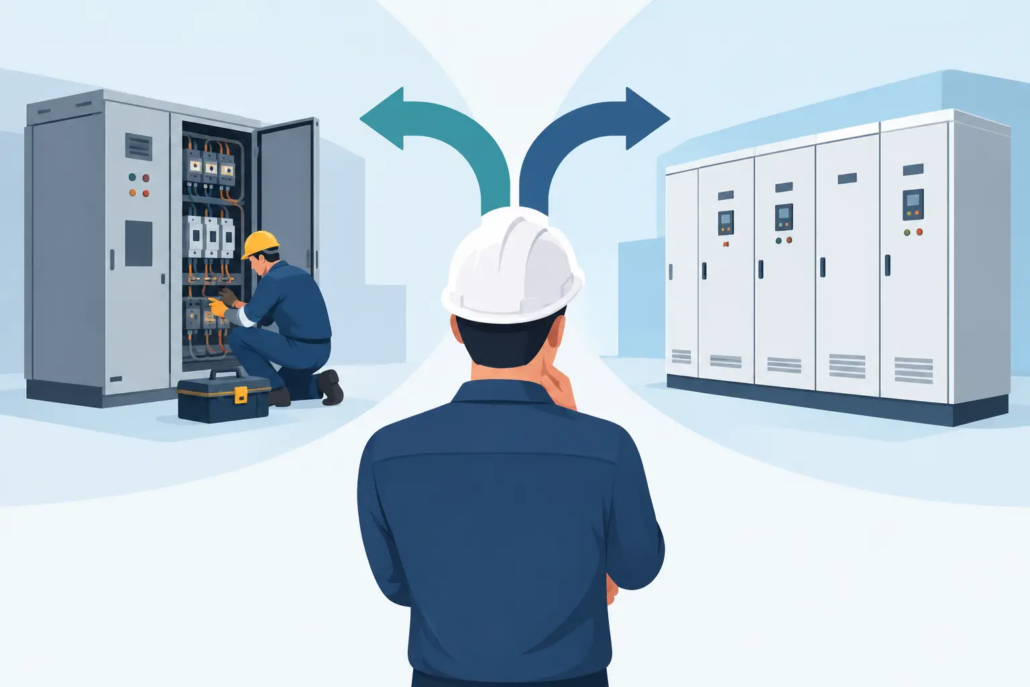
Repair Versus Replace Switchgear Decisions
A main switchgear failure rarely arrives at a convenient time. It can interrupt tenant operations, disable critical building systems, create a safety exposure, and turn a manageable capital decision into an emergency procurement problem. The repair versus replace switchgear question should therefore be answered before the equipment becomes the weak point in a building’s electrical distribution system.
For commercial buildings, multifamily communities, hotels, warehouses, and retail properties, the right decision is not based on age alone. It depends on the equipment’s condition, fault-duty rating, available replacement parts, code implications, capacity needs, and the real cost of an unplanned outage. A licensed engineering assessment brings these factors into one practical, documented decision.
Repair Versus Replace Switchgear: Start With Risk
Switchgear is designed to isolate faults, protect conductors and downstream equipment, and allow power to be controlled safely. When it is compromised, the risk is broader than a single breaker failure. Damaged or unreliable gear can affect elevators, fire pumps, emergency systems, HVAC equipment, domestic water systems, data infrastructure, and tenant operations.
The first question is whether the equipment can still perform its protective function as designed. A switchgear lineup may look serviceable from the outside while containing overheated bus connections, deteriorated insulation, worn breaker mechanisms, corrosion, obsolete trip units, or damage from past water intrusion. These conditions require more than a quick visual review.
A condition assessment should document the make, model, ratings, age, maintenance history, visible defects, and operating history. It should also consider infrared scanning, breaker testing, insulation resistance testing where appropriate, torque verification, and an evaluation of the available short-circuit current at the equipment. The assessment must distinguish between a repairable component issue and a system-level reliability or safety concern.
When Repair Is a Sound Engineering Decision
Repair can be the disciplined choice when the enclosure, bus structure, and fundamental ratings remain suitable for the building and the problem is isolated. For example, a single maintainable circuit breaker may need rebuilding or replacement, a damaged door interlock may require correction, or loose and overheated terminations may be remediated after the cause is identified.
A repair path is generally stronger when replacement parts are listed, available, and compatible with the original equipment; the switchgear’s interrupting rating remains adequate; the equipment has no material corrosion or water damage; and testing verifies acceptable performance after work is complete. The repair must restore safe operation, not simply return power to the building.
Planned repair can also reduce near-term cost and downtime. This matters when a property has a limited shutdown window or when replacement lead times would affect occupancy, construction sequencing, or a pending inspection. However, lower initial cost should not be confused with lower lifecycle cost. Repeated service calls, hard-to-source components, and growing outage risk can quickly erase the apparent savings.
Any repair scope should include clear documentation of the equipment condition, the affected components, test results, corrective work, and remaining limitations. That record helps property owners manage liability, supports future capital planning, and gives facility teams a credible basis for maintenance decisions.
Signs That Replacement Should Move Forward
Replacement becomes the prudent course when switchgear no longer provides a dependable, code-conscious platform for the building’s electrical needs. One major indicator is obsolete equipment with unavailable original parts or uncertain aftermarket solutions. A component that fits physically is not automatically appropriate for the system. It must be evaluated for listing, ratings, coordination, and suitability.
Equipment that has sustained flood exposure, persistent moisture intrusion, significant rust, or corrosion deserves special attention in Florida. Salt air, humidity, and wind-driven rain can degrade enclosures, terminations, bus assemblies, and mechanisms over time. Cleaning the visible evidence may not resolve hidden deterioration or compromised insulation.
Replacement is also often justified when electrical studies show that available fault current exceeds the equipment’s short-circuit current rating. This is a life-safety issue, not a cosmetic upgrade. Changes made by a utility, transformer replacement, generator installation, or system reconfiguration can increase available fault current beyond what older switchgear was designed to withstand.
Other common triggers include repeated breaker trips without a confirmed and corrected root cause, evidence of arcing or thermal damage, deteriorated bus insulation, damaged main devices, and an inability to obtain qualified service support. If a lineup has reached the point where each repair creates another uncertainty, a replacement project provides greater control over safety, schedule, and long-term performance.
Capacity and Code Can Change the Answer
A property may be considering switchgear work because it is adding EV charging, increasing air-conditioning capacity, renovating tenant spaces, installing new commercial kitchen equipment, or modernizing life-safety systems. In these cases, repairing an old lineup may preserve a limitation that the project is trying to overcome.
An electrical load calculation establishes whether the existing service and distribution equipment can support the proposed demand. A short-circuit and protective-device coordination study can confirm whether overcurrent devices are properly selected and coordinated. Arc-flash analysis may also be necessary to define labeling and safer work practices for qualified personnel.
The governing code requirements depend on the scope of work, the authority having jurisdiction, and the edition of the Florida Building Code and National Electrical Code adopted for the project. NFPA 70B provides a recognized framework for electrical equipment maintenance, while NFPA 70E addresses electrical safety in the workplace. These standards do not automatically require replacement of every aging switchgear assembly. They do, however, reinforce the need for documented condition, maintenance, and safe operating practices.
When replacement is selected, the design should not be a simple like-for-like purchase order. The new equipment must be sized and rated for current and anticipated loads, available fault current, environmental conditions, service entrance requirements, selective coordination needs where applicable, and the building’s operational priorities. Permit-ready drawings and specifications reduce ambiguity during bidding, installation, inspections, and final energization.
Compare the Full Cost, Not Just the Proposal Price
The financial comparison between repair and replacement should account for more than the contractor’s immediate price. A repair proposal may be attractive because it requires less capital today. But owners should evaluate the probability and consequence of the next failure, expected maintenance expense, replacement-part availability, shutdown requirements, tenant disruption, insurance exposure, and the effect on planned renovations.
Replacement usually has a higher upfront cost and may involve utility coordination, temporary power, feeder modifications, permits, and a carefully managed outage. Those are real project impacts. Yet a planned replacement gives owners greater ability to schedule work around occupancy, order equipment before an emergency, integrate capacity upgrades, and complete required testing under controlled conditions.
For a condominium or HOA board, this analysis supports a defensible reserve and capital-planning decision. For a developer or contractor, it helps prevent late-stage redesign after a failed inspection or equipment discovery. For a facility manager, it turns a recurring maintenance concern into an actionable risk-management plan.
A Practical Decision Process for Property Owners
The best decisions begin with accurate field information rather than assumptions based on equipment age. Start by collecting one-line diagrams, prior maintenance records, utility data, panel schedules, known outage history, and planned load additions. An on-site engineering review can then verify equipment ratings, physical condition, access, clearances, and conditions that may affect permitting or installation.
From there, the evaluation should establish whether repair is technically sound, what repairs are required, how long that solution is expected to remain viable, and what risks remain. If replacement is recommended, the scope should identify required studies, ratings, outage sequencing, temporary power considerations, permit documentation, and inspection requirements.
For complex or occupied properties, phased work may be the right answer. A building can address immediate hazards and critical repairs while engineering a replacement project that aligns with budgets, lead times, and operational windows. This approach avoids both extremes: delaying a known safety concern and replacing equipment without a verified technical basis.
Boukzam PE Consulting approaches switchgear decisions with licensed PE oversight, field-focused evaluation, and clear documentation built for real project execution. The objective is not to sell a predetermined outcome. It is to establish a safe, code-compliant path that protects occupants, supports reliable operations, and preserves the owner’s investment.
If your switchgear is showing signs of deterioration, has experienced water exposure, cannot support planned upgrades, or has become difficult to maintain, address it while the project can still be planned. A documented engineering assessment gives your team the confidence to act before an electrical failure sets the schedule for you.

