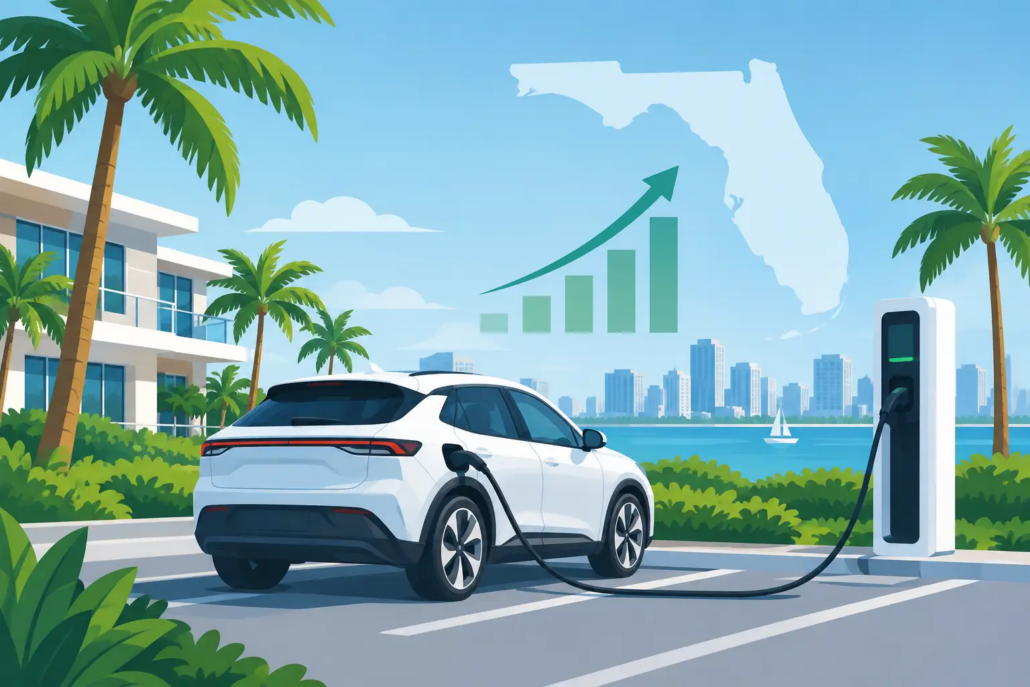
EV Charging Demand Trends for Florida Properties
A parking area can look fully capable of supporting EV charging until the electrical calculations begin. For many Florida properties, the limiting factor is not the number of parking spaces or the desire to offer charging. It is available service capacity, distribution equipment, feeder pathways, utility coordination, and a design that can be permitted and expanded without expensive rework. EV charging demand trends are making that early engineering review a capital-planning priority.
For condominium boards, multifamily owners, developers, and facility managers, the question is no longer whether electric vehicles will affect parking infrastructure. The operational question is how quickly demand will arrive at a specific property and what level of investment is justified now. A practical answer requires more than installing a few chargers. It requires a code-compliant plan built around actual electrical capacity, resident or customer behavior, parking turnover, and future expansion.
EV Charging Demand Trends Are Changing Project Planning
Demand is growing unevenly across property types. A luxury condominium with assigned parking may face a small but persistent group of owners requesting overnight charging. A hotel, retail center, or medical office may need visible charging amenities for guests but experience short, variable dwell times. Industrial facilities may be planning fleet electrification, where charging becomes a critical operating load rather than a tenant convenience.
That difference matters. Installing the same equipment at every site can create either a costly underused asset or a system that cannot meet real demand. Property decision-makers should begin with the use case: Who will charge, how long will vehicles remain parked, how often will charging occur, and who is responsible for electricity costs?
Florida’s market adds another layer of urgency. Dense multifamily development, destination travel, seasonal occupancy, and an expanding base of electric vehicles can increase demand in locations where electrical rooms and site infrastructure were never designed for charging loads. In older properties, available capacity may already be constrained by air-conditioning, common-area equipment, elevators, pumps, and planned renovations.
Electrical Capacity Is the First Design Decision
The number printed on a charging station does not tell the full story. A Level 2 charger may be rated for a substantial continuous load, and several units operating at once can quickly affect existing switchgear, transformers, panels, feeders, and service capacity. The National Electrical Code treats EV charging equipment as a continuous load, which directly affects conductor, overcurrent protection, and equipment sizing.
A qualified engineering assessment should review the existing one-line diagram, utility service information, panel schedules, field conditions, and available capacity. Where documentation is outdated or incomplete, field verification becomes especially important. Assumptions made from an old panel schedule can lead to permit delays, change orders, or equipment that cannot be safely connected.
Capacity analysis does not always result in a service upgrade. In some cases, load calculations show that the building can support a limited initial installation. In others, managed charging can keep aggregate demand within a defined limit. For properties with little remaining capacity, a service, transformer, or distribution upgrade may be unavoidable. The right path depends on the actual system, not a generic charger count.
Why Load Management Has Become More Valuable
Smart load management allows multiple chargers to share a defined electrical capacity. When few vehicles are connected, more power can be available to each vehicle. As demand rises, the system can reduce output across chargers to avoid exceeding the site limit.
This approach can reduce near-term upgrade costs and support phased deployment, particularly in multifamily garages and employee parking areas. It is not a substitute for proper engineering. The design still must account for the charging equipment, controls, communications requirements, electrical protection, and the building’s peak-demand profile.
There are trade-offs. A managed system may extend charging time during high-demand periods, which may be acceptable for overnight resident charging but less suitable for a commercial site where customers expect a quick turnaround. Owners should establish realistic service expectations before selecting charging equipment or a network provider.
Designing for Expansion Costs Less Than Retrofitting Later
The strongest EV charging projects separate immediate installation from long-term readiness. A property may install four active chargers today while preparing conduit routes, spare panel capacity, equipment space, and pathways for additional chargers in later phases. That preparation can prevent future trenching, demolition, garage disruption, and repeated permit work.
For new construction, EV readiness should be coordinated early with electrical rooms, parking layouts, structural conditions, fire protection systems, architectural finishes, and utility requirements. Waiting until construction documents are complete can force rushed revisions and reduce available routing options.
For existing buildings, phased work is often more practical. The first phase can establish a dedicated charging distribution system, metering strategy, and scalable communications architecture. Later phases can add charging stations as demand justifies the investment. This approach helps owners control capital expenses while avoiding a patchwork of independently installed equipment.
A future-ready plan commonly addresses four areas:
- Dedicated electrical capacity or a documented strategy for managed capacity
- Conduit, sleeves, and accessible pathways to parking locations
- Physical space for future panels, transformers, or switchgear where needed
- A clear approach to metering, billing, network access, and operational responsibility
These details should be coordinated with the property’s operating model. In a condominium, the association may need a consistent policy for resident requests, installation standards, electricity reimbursement, maintenance, and liability. In a retail or hospitality setting, ownership may prioritize public access, payment systems, visibility, and uptime. The equipment is only one part of the program.
Code Compliance Extends Beyond the Charger
EV charging design must be coordinated with applicable electrical, building, fire, accessibility, utility, and local permitting requirements. The relevant requirements can vary based on the site, jurisdiction, occupancy, equipment type, parking layout, and whether the project involves new construction or an existing facility.
NEC requirements affect load calculations, wiring methods, grounding and bonding, overcurrent protection, disconnecting means, and the installation of electric vehicle power transfer systems. Florida Building Code provisions and local requirements can affect parking accessibility, site work, structural mounting, fire-rated assemblies, equipment clearances, and permitting documentation. NFPA considerations may also apply to the broader electrical and life-safety environment.
Accessibility deserves early attention. An accessible charging space is not simply a standard accessible parking space with a charger added beside it. The parking layout, access aisle, route to building entrances, charging-cable management, bollards, and equipment placement must work together. Poor layout decisions can create barriers for users, expose equipment to vehicle impact, or require costly correction after inspection.
In parking garages, ventilation, fire protection coordination, vehicle circulation, and protection of electrical equipment also deserve review. In coastal and high-humidity environments, equipment location, corrosion resistance, and weather exposure can influence long-term performance and maintenance costs.
The Utility Timeline Can Shape the Entire Schedule
When an EV project requires a larger service, transformer work, or utility-side modifications, utility coordination can become a critical schedule item. Lead times may affect construction sequencing, equipment procurement, and opening dates. This is one reason electrical capacity should be evaluated before a property commits to charger quantities or announces an installation date.
Clear permit-ready documents reduce uncertainty. They should identify the charging equipment, connected load, distribution modifications, feeder routing, protective devices, site layout, mounting details, and applicable notes needed for construction and inspection. A licensed professional engineer can provide the calculations and coordinated documentation necessary to move a complex project forward with confidence.
Make Demand Data Part of Property Planning
The best time to assess EV charging is before demand becomes an urgent resident complaint, lease negotiation issue, or redevelopment constraint. Owners can begin with a practical inventory: available electrical capacity, parking conditions, existing drawings, planned capital improvements, likely user groups, and whether billing or access control will be required.
From there, an engineered feasibility review can distinguish between a modest first phase, a managed charging program, and a larger infrastructure upgrade. That clarity protects budgets, improves permit readiness, and helps avoid installing equipment that does not match the property’s actual needs.
EV charging is becoming part of a building’s long-term electrical strategy. A disciplined plan gives property stakeholders a better way to respond to demand: build what is needed now, preserve a path for what comes next, and keep safety, compliance, and operational performance in view at every phase.


Leave a Reply
Want to join the discussion?Feel free to contribute!